 Add to Chrome
 Add to Firefox
 Add to Edge
Don't Let a Few Network Failures Slow the Entire AllReduce
Jun 01, 2026
Network failures are among the most frequent hardware faults in large-scale GPU clusters and a leading cause of training-job interruptions. Modern collective communication libraries such as NCCL mitigate network failures by rerouting traffic through surviving NICs on the same server, trading reduced inter-node bandwidth for uninterrupted training. However, the degraded server remains on the critical path of the standard ring algorithm, slowing the entire collective. We present the first information-theoretic lower bound on AllReduce completion time under asymmetric network bandwidth and show that when the straggler retains at least half of its original bandwidth, the unavoidable overhead relative to the fault-free optimum is only O(1/p) for p GPUs. We then design OptCC, a four-stage pipelined AllReduce algorithm that approaches this lower bound. Experiments on SimAI confirm that OptCC closes the gap left by existing fault-tolerant schemes: under practical network failures with up to 50% bandwidth loss, OptCC completes AllReduce within 2-6% of NCCL's fault-free ring performance, whereas the state-of-the-art incurs up to 57% overhead.

LeanSearch v2: Global Premise Retrieval for Lean 4 Theorem Proving
May 14, 2026Proving theorems in Lean 4 often requires identifying a scattered set of library lemmas whose joint use enables a concise proof -- a task we call global premise retrieval. Existing tools address adjacent problems: semantic search engines find individual declarations matching a query, while premise-selection systems predict useful lemmas one tactic step at a time. Neither recovers the full premise set an entire theorem requires. We present LeanSearch v2, a two-mode retrieval system for this task. Its standard mode applies a hierarchy-informalized Mathlib corpus with an embedding-reranker pipeline, achieving state-of-the-art single-query retrieval without domain-specific fine-tuning (nDCG@10 of 0.62 vs. 0.53 for the next-best system). Its reasoning mode builds on standard mode as its retrieval substrate, targeting global premise retrieval through iterative sketch-retrieve-reflect cycles. On a 69-query benchmark of research-level Mathlib theorems, reasoning mode recovers 46.1% of ground-truth premise groups within 10 retrieved candidates, outperforming strong reasoning retrieval systems (38.0%) and premise-selection baselines (9.3%) on the same benchmark. In a controlled downstream evaluation with a fixed prover loop, replacing alternative retrievers with LeanSearch v2 yields the highest proof success (20% vs. 16% for the next-best system and 4% without retrieval), confirming that retrieval quality propagates to proof generation. We have open-sourced all code, data, and benchmarks. Code and data: https://github.com/frenzymath/LeanSearch-v2 . The standard mode is publicly available with API access at https://leansearch.net/ .
Automated Conjecture Resolution with Formal Verification
Apr 04, 2026Recent advances in large language models have significantly improved their ability to perform mathematical reasoning, extending from elementary problem solving to increasingly capable performance on research-level problems. However, reliably solving and verifying such problems remains challenging due to the inherent ambiguity of natural language reasoning. In this paper, we propose an automated framework for tackling research-level mathematical problems that integrates natural language reasoning with formal verification, enabling end-to-end problem solving with minimal human intervention. Our framework consists of two components: an informal reasoning agent, Rethlas, and a formal verification agent, Archon. Rethlas mimics the workflow of human mathematicians by combining reasoning primitives with our theorem search engine, Matlas, to explore solution strategies and construct candidate proofs. Archon, equipped with our formal theorem search engine LeanSearch, translates informal arguments into formalized Lean 4 projects through structured task decomposition, iterative refinement, and automated proof synthesis, ensuring machine-checkable correctness. Using this framework, we automatically resolve an open problem in commutative algebra and formally verify the resulting proof in Lean 4 with essentially no human involvement. Our experiments demonstrate that strong theorem retrieval tools enable the discovery and application of cross-domain mathematical techniques, while the formal agent is capable of autonomously filling nontrivial gaps in informal arguments. More broadly, our work illustrates a promising paradigm for mathematical research in which informal and formal reasoning systems, equipped with theorem retrieval tools, operate in tandem to produce verifiable results, substantially reduce human effort, and offer a concrete instantiation of human-AI collaborative mathematical research.
From Atoms to Trees: Building a Structured Feature Forest with Hierarchical Sparse Autoencoders
Feb 12, 2026Sparse autoencoders (SAEs) have proven effective for extracting monosemantic features from large language models (LLMs), yet these features are typically identified in isolation. However, broad evidence suggests that LLMs capture the intrinsic structure of natural language, where the phenomenon of "feature splitting" in particular indicates that such structure is hierarchical. To capture this, we propose the Hierarchical Sparse Autoencoder (HSAE), which jointly learns a series of SAEs and the parent-child relationships between their features. HSAE strengthens the alignment between parent and child features through two novel mechanisms: a structural constraint loss and a random feature perturbation mechanism. Extensive experiments across various LLMs and layers demonstrate that HSAE consistently recovers semantically meaningful hierarchies, supported by both qualitative case studies and rigorous quantitative metrics. At the same time, HSAE preserves the reconstruction fidelity and interpretability of standard SAEs across different dictionary sizes. Our work provides a powerful, scalable tool for discovering and analyzing the multi-scale conceptual structures embedded in LLM representations.
LeanCat: A Benchmark Suite for Formal Category Theory in Lean (Part I: 1-Categories)
Dec 31, 2025Large language models (LLMs) have made rapid progress in formal theorem proving, yet current benchmarks under-measure the kind of abstraction and library-mediated reasoning that organizes modern mathematics. In parallel with FATE's emphasis on frontier algebra, we introduce LeanCat, a Lean benchmark for category-theoretic formalization -- a unifying language for mathematical structure and a core layer of modern proof engineering -- serving as a stress test of structural, interface-level reasoning. Part I: 1-Categories contains 100 fully formalized statement-level tasks, curated into topic families and three difficulty tiers via an LLM-assisted + human grading process. The best model solves 8.25% of tasks at pass@1 (32.50%/4.17%/0.00% by Easy/Medium/High) and 12.00% at pass@4 (50.00%/4.76%/0.00%). We also evaluate LeanBridge which use LeanExplore to search Mathlib, and observe consistent gains over single-model baselines. LeanCat is intended as a compact, reusable checkpoint for tracking both AI and human progress toward reliable, research-level formalization in Lean.
REAL-Prover: Retrieval Augmented Lean Prover for Mathematical Reasoning
May 27, 2025Nowadays, formal theorem provers have made monumental progress on high-school and competition-level mathematics, but few of them generalize to more advanced mathematics. In this paper, we present REAL-Prover, a new open-source stepwise theorem prover for Lean 4 to push this boundary. This prover, based on our fine-tuned large language model (REAL-Prover-v1) and integrated with a retrieval system (Leansearch-PS), notably boosts performance on solving college-level mathematics problems. To train REAL-Prover-v1, we developed HERALD-AF, a data extraction pipeline that converts natural language math problems into formal statements, and a new open-source Lean 4 interactive environment (Jixia-interactive) to facilitate synthesis data collection. In our experiments, our prover using only supervised fine-tune achieves competitive results with a 23.7% success rate (Pass@64) on the ProofNet dataset-comparable to state-of-the-art (SOTA) models. To further evaluate our approach, we introduce FATE-M, a new benchmark focused on algebraic problems, where our prover achieves a SOTA success rate of 56.7% (Pass@64).
Herald: A Natural Language Annotated Lean 4 Dataset
Oct 09, 2024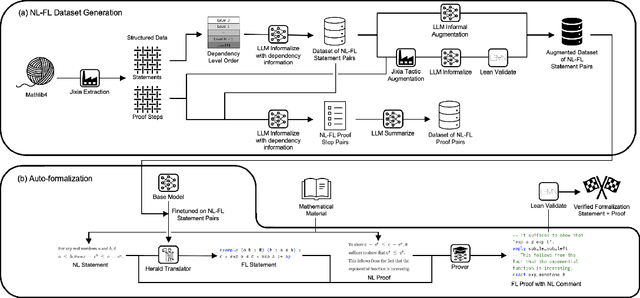

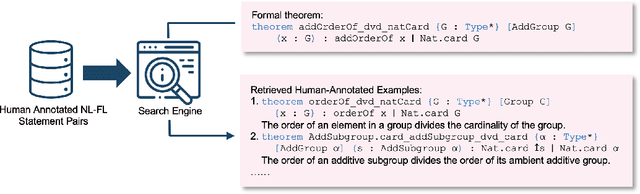
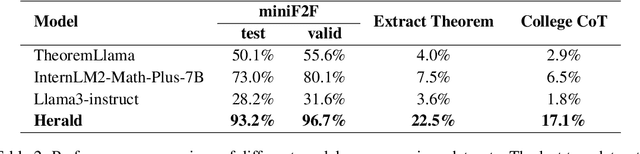
Verifiable formal languages like Lean have profoundly impacted mathematical reasoning, particularly through the use of large language models (LLMs) for automated reasoning. A significant challenge in training LLMs for these formal languages is the lack of parallel datasets that align natural language with formal language proofs. To address this challenge, this paper introduces a novel framework for translating the Mathlib4 corpus (a unified library of mathematics in formal language Lean 4) into natural language. Building upon this, we employ a dual augmentation strategy that combines tactic-based and informal-based approaches, leveraging the Lean-jixia system, a Lean 4 analyzer. We present the results of this pipeline on Mathlib4 as Herald (Hierarchy and Retrieval-based Translated Lean Dataset). We also propose the Herald Translator, which is fine-tuned on Herald. Herald translator achieves a 93.2% accuracy (Pass@128) on formalizing statements in the miniF2F-test and a 22.5% accuracy on our internal graduate-level textbook dataset, outperforming InternLM2-Math-Plus-7B (74.0% and 7.5%) and TheoremLlama (50.1% and 4.0%). Furthermore, we propose a section-level translation framework for real-world applications. As a direct application of Herald translator, we have successfully translated a template section in the Stack project, marking a notable progress in the automatic formalization of graduate-level mathematical literature. Our model, along with the datasets, will be open-sourced to the public soon.
A Semantic Search Engine for Mathlib4
Mar 20, 2024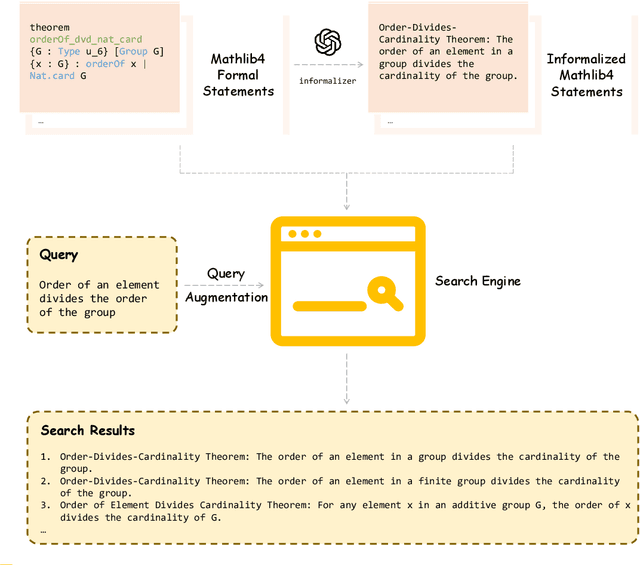
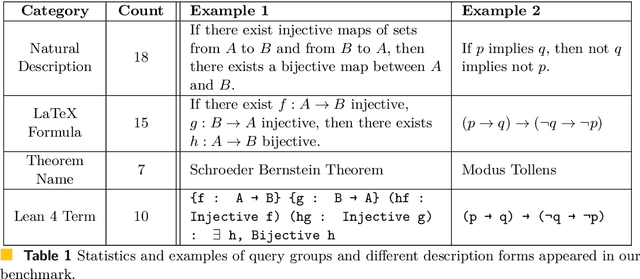
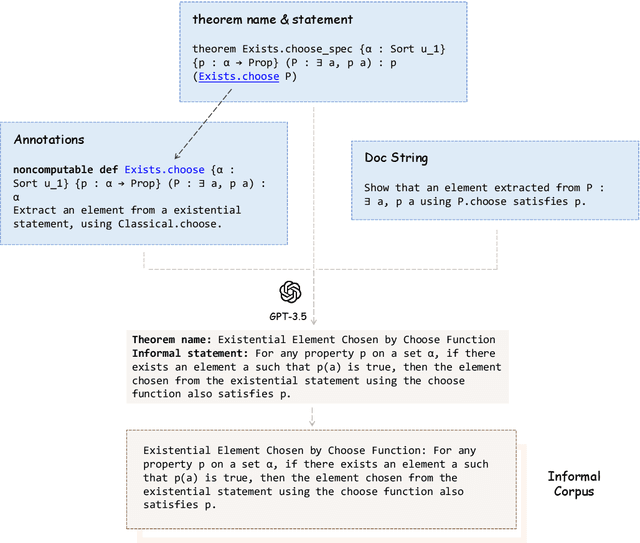

The interactive theorem prover, Lean, enables the verification of formal mathematical proofs and is backed by an expanding community. Central to this ecosystem is its mathematical library, mathlib4, which lays the groundwork for the formalization of an expanding range of mathematical theories. However, searching for theorems in mathlib4 can be challenging. To successfully search in mathlib4, users often need to be familiar with its naming conventions or documentation strings. Therefore, creating a semantic search engine that can be used easily by individuals with varying familiarity with mathlib4 is very important. In this paper, we present a semantic search engine for mathlib4 that accepts informal queries and finds the relevant theorems. We also establish a benchmark for assessing the performance of various search engines for mathlib4.